Welcome to CLPHA's Press Room
CLPHA experts welcome interview requests from print, radio, television, and online reporters and are happy to provide their insights on issues of public housing and related legislation and policy.
For media inquiries, please contact:
David Greer
Director of Communications
(202) 550-1381 or [email protected].
*Please let us know if you are working on deadline.
To view all of CLPHA's press releases, click here.
To view all of CLPHA's press statements, click here.
You can subscribe here to our biweekly newsletter, events invite list, and topic specific newsletters. You can also follow us on Twitter at @CLPHA. Or, send us an email with your interests and we would be happy to add you to our press lists.
Thanks again for your interest in CLPHA!
For Immediate Release: July 2, 2019
CLPHA, Housing Experts Discuss Potential Dangers of HUD’s Proposed Housing Assistance Family Rule
A recording of the call is available HERE.
Washington, DC - Earlier today, immigration and housing experts gathered to address concerns regarding a recently proposed rule by the Trump administration that cruelly targets immigrant families to prevent them from receiving federal housing assistance. Experts discussed how the rule, which would affect about 25,000 households, would cruelly impact families of mixed-status.
The rule, the experts noted, would force families apart as they struggled to keep their current housing threatening many with homelessness, including the 55,000 children who are either U.S. citizens or otherwise eligible for housing benefits and who would be separated from their families
Below are quotes from today’s speakers.
Doug Guthrie, President and CEO, Housing Authority of the City of Los Angeles, said, “If this proposed rule change were to go through it would be devastating for Los Angeles families with mixed immigration status. It would impact as many as 11,600 individuals in assisted housing the majority of whom are young children who are American citizens and it would cost the housing authority millions of dollars. This would likely result in thousands of people becoming homeless at a time when homelessness is already a crisis in Los Angeles.”
Sunia Zaterman, Executive Director, Council of Large Public Housing Authorities, noted, “HUD’s proposal would force mixed status families to decide between a roof for some, or homelessness for all. This is antithetical to the mission of public housing, which is to provide safe, affordable housing to very low-income families. Instead, this proposal would exacerbate crisis levels of homelessness, divert scarce resources from already underfunded public housing authorities, and instill fear and distrust while doing nothing to make our communities safer or better off.”
Diane Yentel, President and CEO, National Low Income Housing Coalition, added, “The cruelty of Secretary Carson’s proposal is breathtaking, and the harm it would inflict on children, families and communities is severe,” said National Low Income Housing Coalition President and CEO Diane Yentel. “Tens of thousands of deeply poor kids, mostly US citizens, could be evicted and made homeless by this proposal, and – by HUD’s own admission – there would be zero benefit to families on waiting lists. This proposal is another in a long line of attempts by the administration to instill fear in immigrants throughout the country. We will not stand for it.”
Arianna Cook-Thajudeen, Bank of America Legal Fellow, National Housing Law Project, said, “The National Housing Law Project opposes this proposed rule because it would have a detrimental impact on the housing stability of millions of families. The federal housing programs in particular serve as a lifeline for many families who are one step away from homelessness. What the Administration is doing is through this proposal is ruthless and reckless. We urge everyone to submit comments to HUD to oppose this rule by July 9th.”
Tory Gunsolley, President and CEO, Houston Housing Authority, remarked, “The current system works. Undocumented occupants are not receiving federal subsidies. The proposed regulations, on the other hand, would cause a needless increase in homelessness and cost the federal government more money. The proposed regulation would force HHA to be an extension of immigration enforcement, a role that does align with our mission to provide safe, affordable housing. It simply doesn't make sense to implement.”
###
The Immigration Hub is a national organization dedicated to advancing fair and just immigration policies through strategic leadership, innovative communications strategies, legislative advocacy and collaborative partnerships.
The Council of Large Public Housing Authorities is a national non-profit organization that works to preserve and improve public and affordable housing through advocacy, research, policy analysis, and public education. CLPHA’s 70 members represent virtually every major metropolitan area in the country. Together they manage 40 percent of the nation’s public housing program; administer more than a quarter of the Housing Choice Voucher program; and operate a wide array of other housing programs. Learn more at clpha.org and on Twitter @CLPHA and follow @housing_is for news on CLPHA’s work to better intersect the housing field and other areas of critical importance such as health and education.
Public Housing Authorities, Community Colleges, College Access Partners Collaborate to Eliminate Barriers to Postsecondary Success
New Report and Recommendations from the Council of Large Public Housing Authorities Highlight Innovative Cross-Sector Collaborations to Improve Postsecondary Achievement for Public Housing Residents and Housing-Insecure Students
Featuring Partnerships in Chicago, Columbus, Los Angeles, Louisville, Tacoma
WASHINGTON (May 16, 2019) – A new report released today from the Council of Large Public Housing Authorities (CLPHA), with support from The Kresge Foundation, showcases the work of five pioneering public housing authorities (PHAs) that are successfully collaborating with postsecondary institutions and local nonprofit organizations to increase college access, retention, and graduation rates for current public housing residents and college students who are experiencing homelessness. “Eliminating Barriers to Postsecondary Success: Cross-Sector Collaborations to Improve Postsecondary Achievement for Students Served by Public Housing Authorities,” identifies key elements of effective cross-sector collaborations and offers a series of recommendations to policy makers, PHAs, and philanthropic foundations seeking to scale, replicate, and invest in partnerships between housing and education organizations.
“The trailblazing public housing authorities featured in our new report, along with their postsecondary partners, are redefining the traditional role of public housing in their communities to reach beyond four walls and a roof,” said CLPHA Executive Director Sunia Zaterman. “With combined expertise from the housing and education sectors, two profoundly siloed systems, the partners are breaking new ground to implement targeted interventions that would not be possible without cross-sector collaboration. By documenting the successes, challenges, and future plans of the five partnerships, “Eliminating Barriers to Postsecondary Success” is an instruction guide to practitioners, policy makers, and philanthropy seeking new cross-sector solutions to serve low-income families.”
The report elevates 11 findings from a November 2018 convening in Washington, D.C., where partners from the Chicago Housing Authority (CHA), City Colleges of Chicago, and One Million Degrees, and the Tacoma Housing Authority (THA) and Tacoma Community College discussed their work to provide financial support and housing opportunities for residents and housing insecure college students; the Housing Authority of the City of Los Angeles (HACLA) and partner Southern California College Access Network (SoCal CAN) detailed their program to facilitate the college application and enrollment process among young residents, and the Columbus Metropolitan Housing Authority (CMHA) and partner Columbus State Community College, and the Louisville Metropolitan Housing Authority (LMHA) with partner Family Scholar House explained their dual generation approaches to ensuring young parents can graduate with a degree.
“Housing insecurity and homelessness can create tragic off-campus barriers to student persistence and success,” said Bethany Miller, program officer with the Kresge Foundation’s Education Program. “But solutions-driven partnerships, including those highlighted in CLPHA’s recent analysis, between postsecondary institutions, government agencies and departments, nonprofit social service providers and public housing authorities can tear down those barriers, ease the anxiety of housing insecurity and help more students persist and succeed in college. We support this work because increased educational attainment among students with limited means is the key to breaking intergenerational cycles of poverty and increasing socioeconomic mobility.”
To announce the release of “Eliminating Barriers to Postsecondary Success: Cross-Sector Collaborations to Improve Postsecondary Achievement for Students Served by Public Housing Authorities,” CLPHA will host a press conference TODAY, May 16, 2019 at 2:30 PM ET during CLPHA's annual Housing Is Summit in Washington, D.C., a two-day meeting devoted to developing and sustaining cross-sector partnerships. The brief press conference will be followed immediately by an on-the-record panel discussion featuring executives engaging in postsecondary partnerships. See below for more details about the press conference and panel, which will both be webcast live at http://bit.ly/2URfFlK.
“Eliminating Barriers to Postsecondary Success” also includes an overview of the federal policies that support and limit postsecondary achievement for students served by PHAs, and profiles of the five partnerships.
Chicago Housing Authority, City Colleges of Chicago, One Million Degrees
“The Chicago Housing Authority is proud to support thousands of residents through CHA scholarships and the Partners in Education program with City Colleges of Chicago,” said Cassie Brooks, assistant director of education for CHA. “In pairing grant aid with individual counseling and holistic student supports from One Million Degrees, we continue toward the goals of increased academic achievement and, ultimately, self-sufficiency. We thank the Kresge Foundation and CLPHA for collaborating with public housing agencies, highlighting resident successes and bringing resident post-secondary programs to the forefront.”
Housing Authority of the City of Los Angeles, Southern California College Access Network
“The increasing complex college-going process requires students and families today to be well versed in the academic requirements, financial options, and application procedures,” said Alison De Lucca, executive director of the Southern California College Access Network. “The Southern California College Access Network is deeply grateful for the partnership we’ve forged with the Housing Authority for the City of Los Angeles to provide one-on-one college advising at the housing sites. For our students, the pathway starts with a conversation, followed by consistent guidance from a skilled college access counselor. As students are admitted to college with solid financial aid packages and the support they need to succeed, a strong message is being sent to all residents that college and career aspirations are within reach. This cross-sector collaboration demonstrates the readiness and need for continued college access support in place-based settings.”
Louisville Metro Housing Authority, Family Scholar House
"The long-standing partnership Louisville Metro Housing Authority has with Family Scholar House has helped hundreds of parents provide a better life and future for their children,” said LMHA Executive Director Lisa Osanka. “More importantly, this partnership is helping to break the generational cycle of poverty and ensuring that more Louisvillians are able to participate in the economic opportunities that exists throughout our community."
“The partnership between Family Scholar House and Louisville Metro Housing Authority has helped make real the dreams of families who have been in need of the stability that is rooted in safe, affordable housing. For our single parents, pursuing dreams of college graduation and new careers begins with a place for them and their children to call home,” said Cathe Dykstra, president and chief executive officer of Family Scholar House. Stronger and more stable families mean stronger and more stable communities.”
Tacoma Housing Authority, Tacoma Community College
“THA’s partnerships with Tacoma Community College and the University of Washington-Tacoma to house homeless or near homeless students is an excellent investment,” said Michael Mirra, executive director of the Tacoma Housing Authority. These students are determined, but without housing their prospects are poor. The degree they seek is a key to their adult prosperity. And since most of them are parents, this is also an investment in the lives and prospects of their children. That makes these partnerships a very good use of scarce housing dollars.”
What: Press Conference and Panel Discussion Announcing CLPHA’s New Report
“Eliminating Barriers to Postsecondary Success: Cross-Sector Collaborations to Improve Postsecondary Achievement for Students Served by Public Housing Authorities”
When: TODAY, May 16, 2019, 2:30 PM ET
Who: CLPHA, The Kresge Foundation, Postsecondary Partners
Press Conference Speakers
Sunia Zaterman, Executive Director, Council of Large Public Housing Authorities
Bethany Miller, Education Program Officer, The Kresge Foundation
Michael Mirra, Executive Director, Tacoma Housing Authority
Alison De Lucca, Executive Director, Southern California College Access Network
Additional Panelists
Jennifer Thomas Arthurs, Director of Strategic Initiatives, Housing Authority of the City of Los Angeles
Cassie Brooks, Assistant Director of Education, Chicago Housing Authority
Erica Walker, Director of Student Development Projects, City Colleges of Chicago
Where: CLPHA's Housing Is Summit
1616 Rhode Island Ave, NW
2nd Floor, Room B
Washington, DC 20009
Webcast Link: http://bit.ly/2URfFlK
RSVP: Jenny Werwa, [email protected]
MEDIA CONTACTS:
CLPHA: Jenny Werwa, [email protected], 202-638-1300x120 / 301-641-5557
Kresge: Kelly Leon, [email protected], 248-643-9630
CHA: Molly Sullivan, [email protected], 312-786-3344
Family Scholar House: Cathe Dykstra, [email protected]
LMHA: Christi Lanier-Robinson, [email protected], 502-609-9141
SoCal CAN: Alison De Lucca, [email protected], 818-742-5583
THA: Brandon Wirth, [email protected], 253-448-2790
About the Council of Large Public Housing Authorities
The Council of Large Public Housing Authorities is a national non-profit organization that works to preserve and improve public and affordable housing through advocacy, research, policy analysis and public education. CLPHA’s 70 members represent virtually every major metropolitan area in the country. Together they manage 40 percent of the nation’s public housing program; administer more than a quarter of the Housing Choice Voucher program; and operate a wide array of other housing programs. Learn more at clpha.org and on Twitter @CLPHA and follow @housing_is for news on CLPHA’s Housing Is Initiative to better insect the housing field and other areas of critical importance such as health and education.
###
Congresswoman Barbara Lee (D-CA) and Renowned Physician Dr. Camara Jones to Present Keynote Remarks
WASHINGTON (May 9, 2019) – Collaborators from the housing, health, and education sectors will convene in Washington, D.C., May 16 and 17 for the fifth national Housing Is Summit hosted by the Council of Large Public Housing Authorities (CLPHA). The event, featuring plenary sessions devoted to ending intergenerational poverty and keynote remarks from Congresswoman Barbara Lee (D-CA) and renowned physician Dr. Camara Jones, will bring together 300 policymakers, practitioners, advocates, and researchers who are committed to developing cross-sector partnerships that improve life outcomes for residents of public and affordable housing.
“Housing is essential, but not sufficient to help low-income families thrive and break the cycle of intergenerational poverty,” said CLPHA Executive Director Sunia Zaterman. “CLPHA, through our Housing Is Initiative, fosters connections between housing providers and health care systems, schools, and community organizations to develop targeted interventions that support families served by public housing authorities. The Housing Is Summit celebrates these partnerships, encourages peer-learning, and highlights the complementary roles local innovation and national advocacy play in developing cross-sector solutions to our greatest collective challenges.”
The Summit opens on May 16 with keynote remarks from Rep. Barbara Lee (D-CA), a long-time activist and champion of ending childhood poverty. Rep. Lee recently worked to secure funding for the congressionally-commissioned landmark study, A Roadmap to Reducing Child Poverty, which was published in February by the National Academies of Sciences, Engineering, and Medicine.
During a plenary session following Rep. Lee’s remarks, Christine James Brown, chief executive officer of the Child Welfare League of America and a member of the board of the National Academies will present A Roadmap to Reducing Child Poverty and the authors’ two packages of policy proposals that would reduce child poverty by 50 percent over the next decade.
Joining James Brown for the plenary, the lead author of the groundbreaking article, A Universal Child Allowance: A Plan to Reduce Poverty and Income Instability Among Children in the United States, Dr. Luke Shafer, associate professor for social work and public policy and director of poverty solutions at the University of Michigan, will discuss the significant impact that a universal child allowance of $250 per month could have on the overall health and well-being of children of all incomes, but especially those living in extreme, $2 per day, poverty.
A second plenary session on Thursday will feature David Williams, policy director of Opportunity Insights, the research group led by Dr. Raj Chetty, who will explore how housing mobility research can guide policy and practice.
The first day of the Summit will also include a press conference at 2:30 PM ET announcing the release of CLPHA’s upcoming report, Eliminating Barriers to Postsecondary Success, which profiles the work of five public housing authorities who are collaborating with college access partners and community colleges to increase postsecondary educational achievement for low-income residents and college students experiencing homelessness. Bethany Miller, education program officer with The Kresge Foundation, will moderate a discussion following the press conference with panelists from public housing authorities and postsecondary partners who are participating in this work.
Additional breakout sessions include presentations from national partners and public housing project leads involved in an innovative multi-state, multi-sector collaboration between public housing authorities and UnitedHealthcare (UHC) Medicaid managed care plans. They will discuss their project, Improving Health by Aligning Housing and Health Systems, which is supported by the Robert Wood Johnson Foundation and uses data and analytics to develop place-based health interventions.
Day two of the conference opens with a keynote presentation from Dr. Camara Jones, a senior fellow at Morehouse School of Medicine and recent past president of the American Public Health Association, who will address the systemic, structural racism and other inequities that underlay health disparities and how the social safety net can be strengthened with this understanding.
Attendees will next participate in their choice of peer-to-peer working roundtable discussions on topics such as data sharing with anchor institutions, educating homeless youth, and using technology to address resident health needs.
Afternoon breakout sessions will feature Dr. Craig Pollack, associate professor of health policy and management at the John Hopkins Bloomberg School of Public Health in a panel discussion with researchers who are evaluating the impact of cross-sector interventions to improve health outcomes; a discussion among representatives from public housing authorities and the U.S. Departments of Housing and Urban Development and Health and Human Services who are working to support long-term housing stability for people who are particularly vulnerable to homelessness; and a case study of the Housing Authority of the City of Pittsburgh’s early childhood education collaboration with Duquesne University and ABK Learning and Development Center to improve life outcomes for residents.
The conference will conclude with a closing plenary session devoted to the role of philanthropy in forging innovative cross-sector collaboration to create long-term change. Representatives from The Gates Foundation, The Kresge Foundation, and Melville Charitable Trust will discuss current projects and impact-investing strategies aimed at expanding opportunity and improving long-term life outcomes for lower-income individuals and communities.
The complete Housing Is Summit agenda is available on CLPHA.org.
Many of the conference sessions will be webcast live at the following links:
May 16: 9:00 AM – 4:00 PM ET, LIVE WEBCAST
May 17: 9:00 AM – 3:30 PM ET, LIVE WEBCAST
Registration for the Housing Is Summit is currently closed. Members of the media who would like to attend the Summit should contact Jenny Werwa at [email protected].
About the Council of Large Public Housing Authorities
The Council of Large Public Housing Authorities is a national non-profit organization that works to preserve and improve public and affordable housing through advocacy, research, policy analysis, and public education. CLPHA’s 70 members represent virtually every major metropolitan area in the country. Together they manage 40 percent of the nation’s public housing program; administer more than a quarter of the Housing Choice Voucher program; and operate a wide array of other housing programs. Learn more at clpha.org and on Twitter @CLPHA and follow @housing_is for news on CLPHA’s work to better insect the housing field and other areas of critical importance such as health and education.
###
|
(Washington, D.C.) October 28, 2021 -- Council of Large Public Housing Authorities (CLPHA) Executive Director Sunia Zaterman released the following statement applauding President Joe Biden’s Build Back Better announcement this morning: “The Council of Large Public Housing Authorities applauds President Biden’s announcement of a $1.85 trillion reconciliation framework with $150 billion targeted to affordable housing, the single largest investment in public housing ever. “For decades, millions of public housing residents have suffered from chronic disinvestment in their neighborhoods, exacerbating health, safety, climate risks, and racial inequities. The Build Back Better Act is historic and transformational in its comprehensive long-term approach by making public housing safe and sustainable for generations to come and significantly expanding rental and homeownership assistance. Stable, affordable housing is foundational to the health and economic well-being of all Americans and to our nation as a whole. This unprecedented and long overdue investment in the preservation and expansion of affordable housing, coupled with the Build Back Better Act’s other investments such as universal prekindergarten, the child tax credit, and climate change remediation, will have an historic impact on reducing poverty and improving the climate. “The Biden administration is delivering on a promise that has been decades in the making. CLPHA strongly supports the Building Back Better Act as a history-making investment in public housing and expanding housing opportunities.”
|
|
|
|
(202) 550-1381
For Immediate Release
October 28, 2021 |
||
|
|
||
|
About the Council of Large Public Housing Authorities
About CLPHA’s Housing Is Initiative |
|
|
|
(Washington, D.C.) October 1, 2021 -- Council of Large Public Housing Authorities (CLPHA) Executive Director Sunia Zaterman released the following statement urging Congress not to cut proposed funding for public housing and rental assistance in the Build Back Better reconciliation bill:
“The transformational Build Back Better Act, proposed by President Biden and currently moving through Congress, will significantly expand the nation’s social safety net by providing safe, quality, and affordable housing to millions of low-income and marginalized families. The $90 billion in expanded rental assistance, $80 billion to preserve public housing, and $37 billion investment in the national Housing Trust Fund that passed the House Financial Services Committee in mid-September represents a significant step forward in federal funding for public and affordable housing. These funding levels are appropriate and justified as they finally make up for generations of chronic neglect and underfunding. For this reason, as negotiations about the size of the reconciliation bill move forward, CLPHA urges Congress to retain the funding levels for expanding rental assistance, preserving public housing, and investing in the nation’s Housing Trust Fund.
“Public and affordable housing has suffered under persistent disinvestment for decades. This has left public housing authorities unable to complete capital improvements, which has helped contribute to the loss of 400,000 affordable homes since 1990. Currently only 1 out of every 4 families who are eligible to receive a Housing Choice Voucher are able to access the program because of a lack of funding. This inadequacy of federal resources not only perpetuates the cycle of poverty, but also costs the American economy about $2 trillion every year in lower wages and productivity because of a shortage of affordable housing in major metropolitan areas.
“CLPHA thanks Speaker Pelosi, Senate Majority Leader Schumer, House Financial Services Chairwoman Maxine Waters, and Senate Housing, Banking, and Urban Chair Sherrod Brown for championing housing throughout their careers and during the negotiations over the Build Back Better reconciliation process. Now Congress must commit to fully funding public and affordable housing at the levels in the House Financial Services Committee bill.”
|
||
|
(202) 550-1381
|
||
|
|
||
|
About the Council of Large Public Housing Authorities
About CLPHA’s Housing Is Initiative |
||
|
(Washington, D.C.) September 14, 2021 -- Council of Large Public Housing Authorities (CLPHA) Executive Director Sunia Zaterman released the following statement supporting President Biden’s nomination of Arthur Jemison to be Assistant Secretary for Public and Indian Housing at the Department of Housing and Urban Development (HUD): “The Council of Large Public Housing Authorities (CLPHA) congratulates Arthur Jemison on his nomination to be Assistant Secretary for Public and Indian Housing at the Department of Housing and Urban Development. Mr. Jemison brings deep experience to the assistant secretary position in community development and public housing, including experience with the Boston Housing Authority, a CLPHA member.
We look forward to working with Mr. Jemison to ensure that the vision of President Biden and Secretary Fudge for improving public housing through recapitalizing the public housing portfolio, expanding the Housing Choice Voucher program, addressing systemic racism, and empowering cross-sector partnerships to improve the outcomes for low-income families becomes a reality. CLPHA will strongly support Mr. Jemison throughout the confirmation process.”
Media Contact: David Greer, CLPHA; [email protected], (202) 550-1381 |
|
|
|
|
||
|
|
||
|
About the Council of Large Public Housing Authorities
About CLPHA’s Housing Is Initiative |
||
The Department of Housing and Urban Development today issued additional information about HUD’s contingency plan so that PHAs administering the HCV program may access their HUD-held Housing Assistance Payment Reserves (HHR) under certain circumstances due the lapse in appropriations.
According to the letter, HAP renewal funds and Administrative Fees are scheduled to be paid on time for February, but HUD recognizes that the funds may not cover the monthly HAP needs as a result of additional leasing or costs.
HUD will allow access to HHR funds in situations where the failure to act “would result in an imminent threat to the safety of human life or the protection of property.”
PHAs may request HAP reserves from HUD under the following circumstances:
- To protect families that are imminent risk of termination of assistance; and/or
- PHAs that were eligible to receive a payment for January 2019 and did not receive it (e.g. first time RAD payments for a project) and need reserves to ensure that the property owner(s) receive(s) a HAP payment to continue assistance and protect the residents at the property.
Read the letter for instructions to request an additional payment covered by the HHR.
For more information on the shutdown’s impact on public and affordable housing, join today’s national conference call at 4:00 pm ET for insights from CLPHA and other housing industry experts. Click here to register.
As the partial government shutdown continues and creates more uncertainty for public housing authorities, CLPHA is collecting information on the impacts and effects of the government shutdown on housing authorities and residents.
We are particularly interested in examples regarding landlord willingness to accept new vouchers from HCV participants, and PHA decisions around issuing new vouchers.
We will be sharing your feedback with our media contacts and coalition partners (please let us know if you do not want your PHA’s name identified).
Please send any information to Emily Warren at [email protected] as soon as possible.
CHCDF National Call to Learn About the Impacts of the Government Shutdown
CLPHA, as a member of the steering committee of the Campaign for Housing and Community Development Funding, will be participating in a national conference call on January 15 at 4:00 PM ET to provide updates on the latest information and guidance on how advocates can engage lawmakers to help end the shutdown.
In response to a January 5 Washington Post article focused on new research about where voucher holders live, CLPHA Executive Director Sunia Zaterman submitted a Letter to the Editor to emphasize examples of PHAs’ innovative housing mobility strategies. Although edited significantly for length, the version published in print and online describes landlord recruitment and retention efforts, and calls for additional local flexibilities and sufficient federal funding.
Today, CLPHA Executive Director Sunia Zaterman was quoted in Affordable Housing Finance discussing how the shutdown threatens the stability of low-income households. Though HUD has prepared payments for housing vouchers and the public housing operating subsidy through February, Zaterman notes that the “existential threat” for voucher holders looms given the uncertainty of when the shutdown will end. If housing authorities cannot utilize HUD funding after February, there is a risk that that they will not be able to pay landlords and that landlords will subsequently begin to evict voucher-holding tenants.
Zaterman added that as HUD funding remains suspended due to the shutdown, local housing authorities are growing increasingly concerned about how they will maintain properties, make repairs, and pay employees.
CLPHA will continue our advocacy in support of PHAs and will provide members with additional news about the shutdown as we learn it.

From the Austin Housing Authority's press release:
The Austin Housing Authority announced today that Pathways at Chalmers Courts has received the 2026 Urban Land Institute (ULI) Austin Impact Award for Best Project Design.
ULI Austin presented the award Aug. 26 at the ULI Austin Impact Awards Ceremony & Celebration, held at Austin PBS on the Austin Community College Highland campus. The annual Impact Awards recognize projects and people helping create better places to live, work and gather across Greater Austin.
Best Project Design goes to a completed project that pairs design excellence with priorities like sustainability, resiliency, healthy places and equitable communities.
"This award is a tremendous honor because it shines a light not only on the architecture of Pathways at Chalmers Courts, but also on the positive impact this community is having in East Austin," said Michael Gerber, president and CEO of the Austin Housing Authority. "Chalmers is modern, sustainable and beautifully designed, but what makes it truly special is that residents were at the center of every decision - from how the community was rebuilt in phases to the design of the buildings and shared spaces. It shows what is possible when affordable housing is created with the same ambition, quality and care as any other community."
Chalmers Courts opened in 1939 as one of the nation's first public housing communities. Its redevelopment unfolded in three carefully sequenced phases and wrapped in October 2024, replacing 158 aging apartments with 398 new, affordable homes. Families didn't have to leave the neighborhood to get there: residents stayed in their existing units until new homes were built directly across the street, then moved into the finished community.
Residents helped design that community. Surveys, workshops and design votes shaped decisions on building orientation, exterior materials, decorative screens and public spaces. The result pairs greater housing density with shaded courtyards, recreational areas and preserved heritage trees, and turns a former street into a Greenway for pedestrians and cyclists connecting Chalmers to the surrounding neighborhood.
Rooftop solar offsets a portion of the development's power needs. Passive solar orientation, natural shading, rain gardens, biofiltration ponds and native landscaping cut energy use and manage stormwater, while durable, low- and no-VOC materials keep homes healthier to live in.
The community also includes a Boys & Girls Club, medical and dental services, classrooms, resident services offices, fitness centers, gathering spaces, a sports court, playgrounds and a splash park. Together, they're designed to support residents and strengthen the surrounding East Austin community.
The Austin Housing Authority developed Pathways at Chalmers Courts with Carleton Development, Nelsen Partners, DWG, Connect Structural, Dunaway and PHA Consulting Engineers.
Learn more about Pathways at Chalmers Courts at austinha.org.
From the Oklahoma City Housing Authority's press release:
This week, the Oklahoma City Housing Authority (OCHA) and the City of Oklahoma City were awarded a $25,115,577 grant from the Choice Neighborhoods program from the U.S. Department of Housing and Urban Development (HUD).
The grant will help revitalize the Will Rogers Courts housing development and the Westwood Exchange neighborhood. The neighborhood is bordered between the Oklahoma River and SW 22nd Street to the north and south, the Oklahoma National Stockyards to the west and South Douglas Ave. to the east.
“The residents are the true beneficiaries, because this grant gives them the power to build the Westwood Exchange neighborhood of their dreams,” said Mark Gillett, Executive Director of OCHA. “Over the past several years, OCHA hosted a dozen community meetings, and we will host many more over the next eight years to ensure that the community’s voice remains central to our redevelopment work.”
In partnership with Community Action Agency, Lilyfield, Brinshore Development and dozens of other committed partners, the Choice Neighborhoods grant will support the revitalization of the neighborhood and fully rebuild the housing development following the plan revealed to the community last fall.
The Stockyards City neighborhood, which includes Westwood Exchange, is also participating in the city’s Strong Neighborhoods Initiative, which will provide investment in new homes, sidewalks, signage, trees, parks and public art.
"This $25 million grant from HUD is validation of the work we have been doing to support the housing needs of those in our city who need it most,” Mayor David Holt said. “Through MAPS 4, our 2025 bond issue and other resources, our city has previously committed $33 million to the renewal of the Westwood Exchange area. This HUD grant will bring the total commitment from all sources to $227 million. The capital efforts are amazing on their own, but this grant goes further, supporting education, job connections, and long-term support that will help the people of Westwood Exchange thrive. On behalf of the people of Oklahoma City, I thank HUD for this support, as we look forward to the progress to come.”
In addition to the funding from HUD, financial and in-kind commitments to this project from organizations across Oklahoma City total more than $227 million. These commitments include $77M in federal, state and local government resources, $49M in housing, $35M in neighborhood resources and $66M in people-focused programs are committed to the project.
The 348 units currently at Will Rogers Courts will be replaced with mixed-income housing, and residents can expect neighborhood projects like a new gateway entrance to the neighborhood, increased access to fresh food through an urban farm and a new Head Start space for children in the area.
"This award reflects the hard work by OCHA, our residents, the City and our community partners who came together around a bold, community-driven vision for the future," said Rocky Chavez, Chair of OCHA's Board of Commissioners. "The Board and I are incredibly proud of Mark and the OCHA team for reaching this milestone, and we’re excited for the opportunity to bring that vision to life and deliver meaningful, lasting results for residents and the broader community.”
The eight-year, multi-phase project will start as engagement with current residents. The first new units are expected to be available for occupancy starting in 2029.
Since 2023, OCHA and its partners have worked closely with the community to strategically develop a plan to revitalize Westwood Exchange. The plan was informed by meetings and feedback sessions with residents, community members and local businesses.
Oklahoma City is one of four cities nationwide receiving a Choice Neighborhoods Implementation grant this year. The other recipients include Gainesville, Florida, Fayetteville, North Carolina and New Bern, North Carolina.
From the Chicago Housing Authority's press release:
Chicago Housing Authority youth unveiled a new large-scale community mural they created this summer on the rear exterior wall of the Hyde Park Art Center. The youth, ages 18-24, worked alongside acclaimed mural artist Dorian Sylvain, collaborating to design and paint the mural that will remain on display for the next three months.
The project marks the second collaboration between CHA and Hyde Park Art Center, providing young residents with hands-on artistic experience while fostering teamwork, creative expression, and meaningful connections with the Hyde Park community.
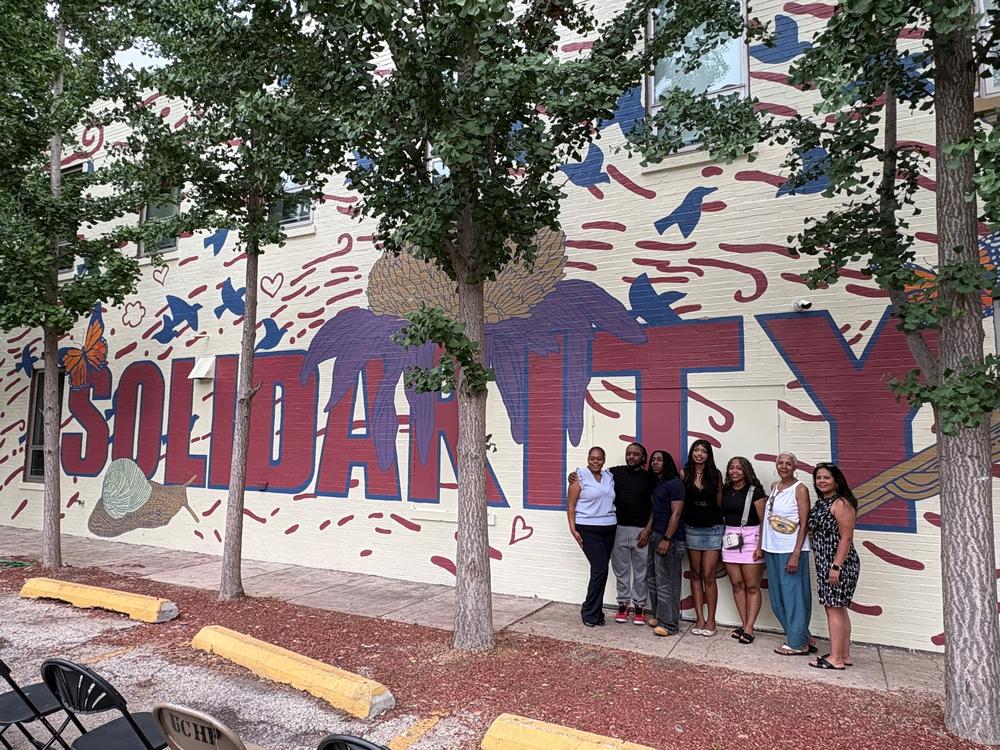
The initiative is part of CHA's Summer 2026 Youth Employment Program, which has provided more than 2,300 young residents with paid summer jobs, exposing participants to career pathways, educational opportunities, and experiences that help prevent summer learning loss.
The colorful mural pays tribute to the immigrant community and spells out the word “Solidarity.”
Artist Josiane Johnson said she was impressed by the people she met and what they were able to accomplish since June 24.
“I definitely feel very proud of being able to complete something on such a large scale,” Johnson said. “My biggest dream in life is to create something beautiful with a message for people to see, and now, I almost have to think of something new. It was such a beautiful process. I feel grateful for the CHA.”
Artist Randy Garvin said: “Before this, I never saw myself doing a mural, and I never would have called myself an artist. But coming here every day and giving my all really helped me define what an artist is to me. I have some amazing people next to me and the whole group made it so much better. That’s why we have this word ‘Solidarity.’”
Garvin also learned how to operate a platform lift.
“At first, I was like, ‘Wow, how is that going to hold three people on here,’ but then you learn that you have to back it up and turn it to the correct corners,” he said. “With this little sidewalk, there was only so much space you could you use but I’m glad I learned that skill.
“Working on this project has taught me a lot about life, more than I expected to learn, and I forever thank CHA for providing me with this opportunity.”
Sylvain gave high praise to the Hyde Park Art Center and CHA.
“CHA has really provided us with some quality young people who are curious, anxious to learn and show up ready to go,” she said. “One of the things we established last year doing the mural is we did not want to limit the participants to young people who felt they were trying to pursue an art career or young people who felt they had to have art skills. We were interested in people who were interested in learning. We got a great variety of young people who applied, were accepted, and started.”
CHA Program Specialist Joanna Adjei said: “One of the things that we look for in partners is our young people being able to feel safe. Dorian and the Hyde Park Art Center make our young people feel so valued. We are going to continue to grow our partnership and provide these opportunities to our young people.”